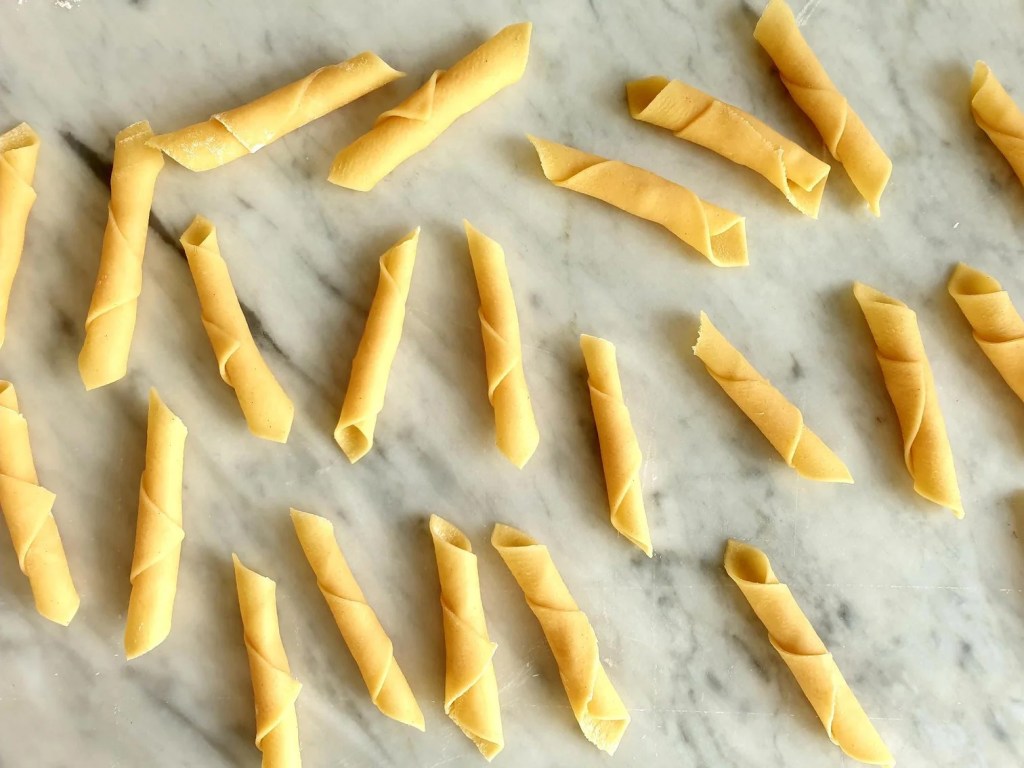
In the rolling hills of Istria, where olive groves meet the Adriatic coast, two handmade pasta shapes have held a place of honor on family tables for centuries: fuži and pljukanci. These humble yet elegant creations are far more than simple noodles — they are edible symbols of Istrian identity, patience, and the art of making something extraordinary from the simplest of ingredients.
Fuži: The Quill-Shaped Classic
Fuži (pronounced FOO-zhee) are perhaps Istria’s most iconic pasta. Made from a basic dough of flour, eggs, water, and a touch of olive oil, the magic lies entirely in the shaping. Small squares of thinly rolled dough are wrapped diagonally around a pencil or wooden stick, then pressed together to form a distinctive quill or tube shape.
The result is a pasta with just enough texture and structure to cradle rich sauces in its folds. Traditionally, fuži are the pasta of choice for Istria’s most celebrated dishes — served with tartufi (truffles) in a simple butter sauce, paired with slow-cooked game goulash made from wild boar or venison, or tossed with a hearty chicken or beef stew known as peteština.
Every Istrian grandmother has her own subtle variation: some roll the dough a touch thicker, others prefer a tighter curl. But the principle remains the same — each piece is shaped by hand, one at a time, making a batch of fuži an act of quiet devotion.
Pljukanci: Rustic and Effortless
Where fuži are precise and elegant, pljukanci (pronounced PLYOO-kahn-tsee) embrace a more rustic charm. The name itself comes from the Croatian verb pljukati, loosely meaning to press or pinch — and that’s essentially how they’re made.
Small pieces of dough are simply rolled and pressed between the palms or against a wooden board, creating short, irregular, slightly twisted shapes. No two pljukanci look alike, and that’s precisely the point. Their uneven surfaces and varied thickness give them a wonderful ability to absorb and hold sauce in every nook and cranny.
Pljukanci are often served with similar accompaniments as fuži — truffles, wild asparagus, seasonal mushrooms, or slow-braised meats. They’re considered the everyday pasta, the one you make when time is short but standards remain high.
More Than Pasta
What makes fuži and pljukanci special isn’t complexity — it’s the opposite. Both use just a handful of pantry staples. Both require hands, a flat surface, and a bit of time. In an era of industrial food production, these pasta shapes endure because they carry something that can’t be mass-produced: the memory of hands working dough, of kitchens filled with flour dust, of meals that bring families together.
Across Istria today, from rustic konobas (taverns) in the hilltop villages of Motovun and Grožnjan to fine-dining restaurants along the coast, fuži and pljukanci remain on nearly every menu. They connect the present to a culinary tradition that stretches back generations — proof that the best food is often the simplest.
If you ever find yourself in Istria, sit down at a table where these pastas are made fresh. Order them with shaved truffles or a rich boškarin beef stew. And as you take that first bite, know that you’re tasting something that has nourished this land for a very long time.
Planning your Istrian adventure? Explore our Istria Food & Wine Guide or browse our Complete Istria Travel Guide.
 Istria.me
Leave a comment