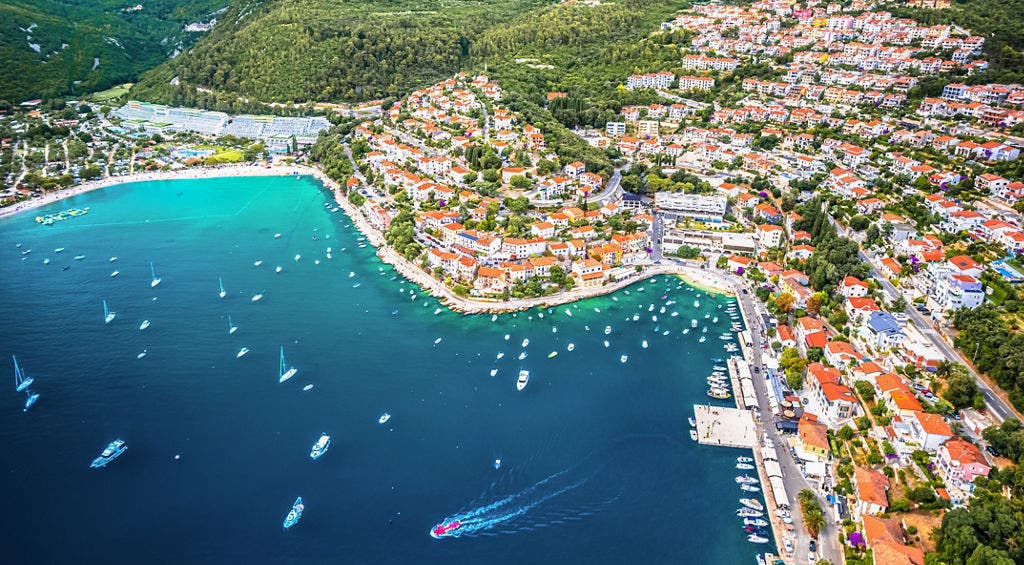
Istria’s western coast gets most of the attention. Rovinj, Poreč, Novigrad — those are the names that fill the brochures and dominate the Instagram feeds. But drive east, through the hills and over the spine of the peninsula, and you’ll reach a stretch of coastline that feels like a different world entirely. Rabac sits here, tumbling down a steep hillside to a crescent of turquoise water, facing not the open Adriatic but the sheltered embrace of Kvarner Bay. There’s a reason people have been calling it a pearl for generations.
I grew up hearing that nickname and rolling my eyes at it — every coastal town in this part of the world claims to be a pearl of something. But Rabac actually earns it. The water here is extraordinary, the setting is dramatic, and the town has a personality that’s distinct from anything on Istria’s western side.
The Beaches
Let’s start with the obvious, because the beaches are what draw most people. Rabac’s main beach, Girandella, curves along the bay with white pebbles sloping into water so clear you can count the stones on the bottom from ten metres away. On a calm morning, before the families arrive with their umbrellas and coolers, it’s genuinely beautiful — the kind of swimming you remember long after you’ve dried off.
But the real prizes are the smaller coves tucked along the coastline in both directions. Walk south past the hotels and you’ll find a series of rocky inlets fringed by pine forest, each one quieter than the last. Some are accessible only by scrambling down steep paths through the macchia, which keeps the crowds thin. Bring water shoes, a towel, and nothing else. The snorkelling along these rocky stretches is some of the best on Istria’s eastern coast — sea urchins, small fish darting through the rocks, and water visibility that can reach fifteen metres on good days.
North of town, the Lungo Mare coastal path leads to more swimming spots, winding through pine shade with views across the bay to the island of Cres. It’s an easy walk, flat enough for anyone, and the benches placed along the route are perfectly positioned for doing absolutely nothing.
Labin: The Town Above
You can’t talk about Rabac without talking about Labin, because the two are inseparable. Labin sits at the top of the hill, about four kilometres above Rabac, and it’s one of Istria’s most characterful hilltop towns. Where Rabac is beach and sea and holiday ease, Labin is narrow medieval streets, crumbling palazzos, artist studios, and a history that runs surprisingly deep.
Labin was a coal mining town for centuries — the last mine closed in the 1990s — and that industrial past gives it a grittiness that most Istrian hilltop towns lack. The old town has been gradually reinvented as an art colony, with galleries and workshops tucked into restored stone buildings. During summer, the Labin Art Republic festival fills the streets with exhibitions, performances, and installations. It’s not polished in the way that Grožnjan is; it’s rougher, more experimental, and more interesting for it.
The view from Labin’s fortified walls is worth the climb alone. You look down over Rabac and the bay, across to Cres and the Kvarner islands, and on clear days all the way to the peaks of the Gorski Kotar mountains on the mainland. It’s one of the great panoramas in Istria, and it comes without a ticket price or a queue.
The Eastern Coast Difference
Istria’s eastern coast has a different character to the west, and Rabac embodies it. The landscape is steeper, wilder, more forested. The towns are smaller and fewer. The tourism infrastructure is present but less dominant — you won’t find the mega-resorts and marina complexes that line the road between Poreč and Rovinj. What you will find is a coastline that feels closer to nature, where the forest comes right down to the water and the evening air smells of pine resin and salt.
The eastern coast also faces the Kvarner rather than the open sea, which means the water tends to be calmer, warmer in sheltered bays, and cleaner than almost anywhere in the Mediterranean. The marine life is richer too — the Kvarner Channel is home to a resident population of bottlenose dolphins, and sightings from the shore aren’t uncommon, especially in the quieter months of early summer and September.
Where to Eat
Rabac’s waterfront has the usual run of tourist restaurants, and they’re fine for a pizza or a plate of grilled squid with a view. But for something better, go up to Labin. The old town has a handful of restaurants that take Istrian cooking seriously without charging Rovinj prices.
Look for places serving štruklji (rolled pastry with cottage cheese or truffles), maneštra with seasonal vegetables, and fresh pasta with game sauce — the interior Istrian dishes that reflect the hillside setting rather than the coast. The lamb from the eastern Istrian hills is excellent and underappreciated, often slow-roasted with potatoes and herbs in a peka (a bell-shaped lid covered in embers). Paired with a glass of local Teran — the deep, tannic red wine that grows on the terra rossa soil of this part of Istria — it’s a meal that anchors you to the place.
For seafood, the small konobas just outside Rabac along the coast road are worth seeking out. They’re the kind of places that don’t advertise, don’t have websites, and serve whatever came off the boats that morning.
When to Come
July and August are busy — Rabac is popular with Italian and Slovenian families, and the beaches fill up. If you have the flexibility, come in June or September. The water is warm enough for swimming, the days are long, but the town breathes easier. Labin’s art scene is most active in July and August, so there’s a trade-off. My favourite time is late September, when the light turns golden, the sea is at its warmest, and you can have an entire cove to yourself on a Tuesday morning.
Rabac doesn’t compete with the western Istrian towns and doesn’t try to. It offers something different — better water, wilder landscape, a hilltop town with real character above it, and the quiet confidence of a place that knows what it is. If your idea of the perfect Istrian day involves swimming in impossibly clear water, eating grilled fish under pine trees, and finishing with wine on a medieval terrace overlooking Kvarner Bay, this is where you need to be.
Planning your Istrian adventure? Explore our Best Towns & Villages in Istria or browse Complete Istria Travel Guide.
 Istria.me
Leave a comment