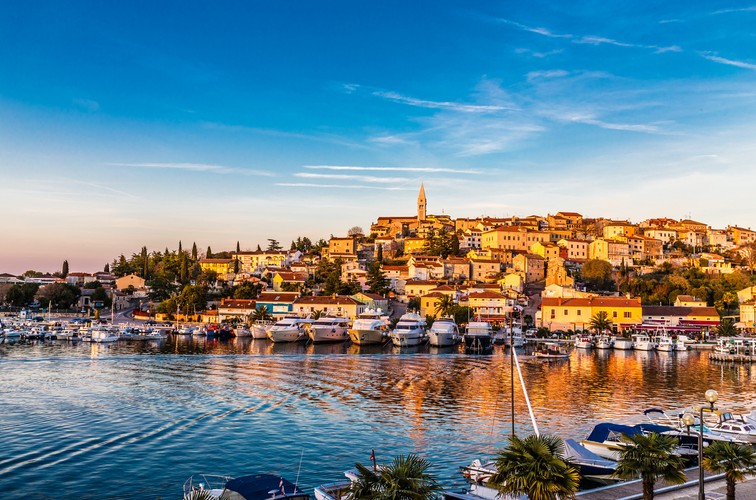
There are towns in Istria that everyone visits — Rovinj, Poreč, Motovun — and then there are the ones that sit quietly between them, waiting for you to notice. Vrsar is one of those towns. Perched on a low hill above a harbour full of fishing boats, looking out across the Lim Fjord, it has a quality that’s hard to describe until you’re there: a kind of unhurried creative energy, shaped by centuries of stone, sea, and sculpture.
I’ve always thought Vrsar is best understood not as a beach destination or a stopover on the way to somewhere else, but as a place where art and landscape have been in conversation for a very long time.
Dušan Džamonja and the Sculpture Park
Vrsar’s identity as a sculptor’s town traces back to one name above all: Dušan Džamonja. The Croatian sculptor of Serbian origin chose Vrsar as his home and workspace, drawn by the landscape and the light. His studio and sculpture park sit on a hillside just outside the old town, surrounded by olive groves and Adriatic views, and the collection of monumental abstract works in metal and stone is unlike anything else on the Istrian coast.
Džamonja’s sculptures are massive, often geometric, and deeply connected to their setting. They don’t compete with the landscape — they emerge from it. Walking through the park, you encounter works half-hidden by Mediterranean scrub, metal forms catching the afternoon light, and stone pieces that seem like they’ve been there as long as the bedrock beneath them. It’s one of those rare outdoor sculpture experiences where the art and the environment genuinely enhance each other.
The park is open to visitors, though it operates quietly — no gift shop, no audio guide, no crowds. That’s part of its appeal. You wander, you look, you sit on a stone wall and take in the view of the archipelago, and nobody rushes you.
The Montraker Sculpture Symposium
Vrsar’s connection to sculpture goes beyond one artist. Since 1961, the town has hosted the Montraker International Sculpture Symposium, one of the longest-running events of its kind in the world. Every year, sculptors from different countries come to Vrsar to work with local stone — the same limestone that built the town itself — creating pieces that are then placed throughout the area.
The result, accumulated over more than six decades, is a town where sculpture is simply part of the fabric. You’ll find works in parks, along pathways, at intersections, on the waterfront — not behind glass or roped off, but right there in the daily life of the place. Children climb on them, old men sit beside them, cats sleep under them. For anyone interested in public art, this accumulation of work across generations is fascinating.
The symposium still happens every summer, and if your timing is right, you can watch sculptors at work in the open air, shaping blocks of stone with hand tools and patience. It’s a reminder that making things slowly is still a valid approach in a world that’s forgotten how.
The Old Town
Vrsar’s old town is small — you can walk its narrow streets in twenty minutes — but it rewards attention. The stone buildings climb the hillside in tight clusters, connected by stairways and passageways that open suddenly onto views of the sea or the fjord. At the top sits the Romanesque church of St. Martin and the remains of the bishop’s castle, both testament to a time when Vrsar was an important ecclesiastical centre.
What I like about the old town is its honesty. It hasn’t been over-restored or turned into a shopping arcade. Some buildings are beautifully maintained; others show their age. There are a couple of galleries, a few konobas, a gelato place that gets busy on summer evenings, and not much else. That’s the point. Vrsar doesn’t try to be more than it is, and what it is turns out to be enough.
The harbour below is the town’s social centre — fishing boats on one side, pleasure craft on the other, and a long promenade where everyone ends up at some point during the day. In the early morning, fishermen unload their catch. By evening, the restaurants along the water fill up with families and couples watching the sunset turn the Lim Fjord gold.
The Lim Fjord
Technically, it’s a ria — a drowned river valley — not a fjord, but nobody in Istria is going to correct you. The Lim Channel stretches about ten kilometres inland from the coast, cutting a dramatic gorge between steep, forested hillsides. It’s one of Istria’s most striking natural features and it sits right on Vrsar’s doorstep.
The channel has been used for shellfish farming for decades, and the mussels and oysters that come out of its waters are exceptional. Several small operations along the shore sell fresh shellfish directly, and a few restaurants at the mouth of the channel serve them simply — raw oysters with lemon, mussels steamed in local white wine, grilled fish from the morning catch. The setting does most of the work: tables on the water’s edge, cliffs rising behind you, the quiet of a place where nature hasn’t been pushed aside.
You can explore the Lim by boat — small excursions run from Vrsar’s harbour — or walk the trails along its rim for elevated views. The forest above the channel is dense and cool even in summer, a mix of holm oak and maquis that smells of rosemary and pine resin.
Why Vrsar Works
Vrsar doesn’t have the postcard-perfect architecture of Rovinj or the Roman mosaics of Poreč. It doesn’t need them. What it has instead is a coherence — a sense of a place that has stayed true to its character while the coast around it has changed. The sculpture tradition gives it cultural depth without pretension. The Lim Fjord gives it natural drama without the crowds. And the town itself, compact and unpretentious, gives you room to breathe.
If you’re staying on the western Istrian coast, give Vrsar more than a drive-through. Spend a morning in the sculpture park, eat shellfish at the Lim Channel for lunch, wander the old town in the late afternoon heat, and sit on the harbour wall with a glass of Malvazija as the fishing boats come in. That’s a day well spent, and you won’t have to share it with a cruise ship crowd.
Casanova visited Vrsar in the 18th century and apparently enjoyed himself — there’s a bench with his likeness on the waterfront now, which locals find more amusing than anything. But the real reason to come isn’t historical celebrity. It’s the chance to see a small Istrian town that has found a way to be quietly remarkable, one sculpture at a time.
Planning your Istrian adventure? Explore our Best Towns & Villages in Istria or browse Things to Do in Istria.
 Istria.me
Leave a comment