Most people pass through Fažana on their way to somewhere else. They park, buy a ticket, board the boat to Brijuni, spend the day in the national park, come back, and drive away. I understand the impulse — Brijuni is spectacular. But treating Fažana as nothing more than a ferry dock is like treating an airport as just a runway. You’re missing the town itself, and Fažana is worth staying for.
It sits on the southwestern Istrian coast, just eight kilometres north of Pula, facing the Brijuni archipelago across a narrow channel of Adriatic so blue it almost looks artificial. It’s a fishing town at heart — always has been — and that identity shapes everything about it, from the morning routines at the harbour to the menus at the waterfront restaurants to the unhurried rhythm of life in its narrow streets.
The Harbour
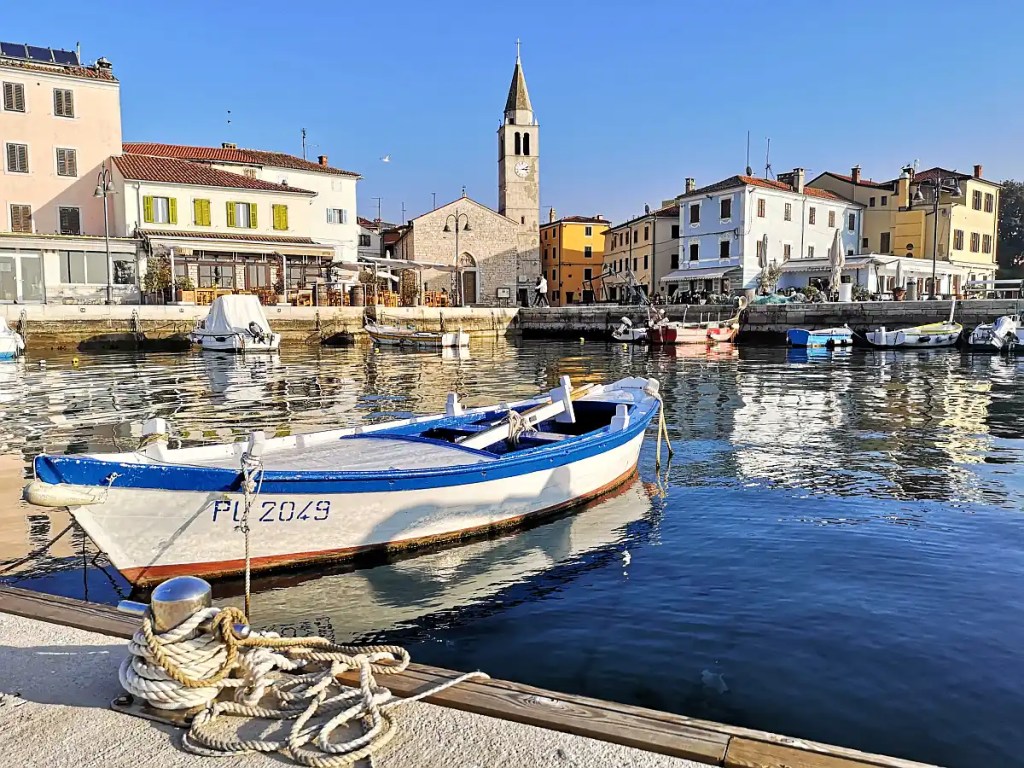
Fažana’s harbour is the kind of place that makes you want to sit down and not get up for a while. It’s small — a curve of stone quay lined with colourful fishing boats, a row of waterfront restaurants with tables practically on the water, and a view across to the dark green silhouette of Veliki Brijun. In the early morning, fishermen sort their nets and unload the night’s catch. By mid-morning, the excursion boats start loading tourists for Brijuni. By evening, the whole waterfront becomes a long, informal dinner table where locals and visitors mix over grilled fish and local wine.
What makes it special isn’t any single thing but the atmosphere — that particular Istrian coastal quality of life happening at its own pace, indifferent to whatever urgency you brought with you. Find a table, order a carafe of house white, watch the boats, and let the evening happen.
Brijuni: The National Park
You can’t write about Fažana without writing about Brijuni, because the two have been linked for over a century. The Brijuni Islands — fourteen of them, though only Veliki Brijun is open to regular visitors — became a national park in 1983, but their story goes back much further. The Viennese industrialist Paul Kupelwieser bought the islands in 1893, eradicated malaria with the help of Robert Koch, and turned them into an exclusive Adriatic resort. Later, Tito made Brijuni his summer residence, hosting world leaders and keeping an exotic animal collection that included elephants, zebras, and a parrot that allegedly outlived him.
Today’s Brijuni is a strange and wonderful mix of all that history. You’ll find Roman villa ruins alongside Tito-era modernist architecture, a small safari park with descendants of his animal collection grazing among ancient olive trees, a Byzantine fortress, and some of the most beautiful Mediterranean parkland you’ll ever walk through. The combination shouldn’t work, but it does — partly because the island has been protected from development for so long that nature has had time to weave everything together.
The standard boat tour from Fažana gives you a few hours on Veliki Brijun with a guided electric train ride around the island. It’s fine as an introduction, but if you can arrange to stay longer — there are a couple of hotels on the island — the experience deepens considerably. Walking the island at your own pace, swimming from its empty beaches in the late afternoon, watching the sunset from the Verige Bay ruins without another tourist in sight — that’s the Brijuni that stays with you.
The Old Town
Fažana’s old town is modest in scale but full of quiet details. The parish church of Saints Cosmas and Damian, dating to the 15th century, sits at the town’s centre with a campanile that serves as the visual anchor from every direction. Inside, there are some surprisingly fine frescoes and a wooden ceiling worth looking up at. Around the church, the streets are narrow and stone-paved, with houses pressed close together in the old Mediterranean fashion — thick walls, small windows, laundry strung between buildings.
The town’s most unexpected cultural feature is its tradition of painted Easter eggs — not the delicate, decorative kind, but large wooden eggs painted by local and international artists, displayed throughout the town. The Fažana Easter Egg collection has grown into something genuinely interesting, with works ranging from folk art to contemporary abstraction, scattered through the streets like an open-air gallery. It’s the kind of quirky, community-driven thing that gives a small town character you can’t manufacture.
The Fish
Fažana’s relationship with fish runs deep — literally. The sardine has been the town’s symbol and economic backbone for centuries, and every August, the Sardine Festival (Ribarska Festa) takes over the harbour for an evening of open-air grilling, music, and the kind of communal eating that feels increasingly rare. Thousands of sardines cooked over open fires right on the waterfront, served with bread and local wine — it’s elemental cooking, and it works.
Beyond the festival, Fažana’s restaurants are some of the best on this stretch of coast for seafood. The fish comes from the channel between the town and Brijuni, which is rich fishing ground, and most places serve it with minimal fuss — grilled whole, drizzled with olive oil, served with blitva (Swiss chard with potatoes). Look for the smaller, less decorated places along the harbour and in the back streets. If the menu is short and handwritten, you’re probably in the right spot.
For something more refined, a couple of restaurants in town have started doing creative things with the local catch — ceviche-style preparations, raw fish with Istrian olive oil and citrus, seafood risottos that balance tradition with technique. The standard is high, and the prices, compared to similar coastal towns in Italy or even Rovinj, remain remarkably fair.
Practical Matters
Fažana is an easy base if you’re exploring southwestern Istria. Pula and its Roman amphitheatre are ten minutes south. The Cape Kamenjak nature reserve — arguably the most beautiful stretch of coastline in all of Istria — is about twenty minutes further. Rovinj is half an hour north. And of course, Brijuni is a fifteen-minute boat ride away.
Accommodation ranges from small family-run apartments to a handful of boutique-style hotels. There’s nothing massive or resort-like, which is part of the appeal. Parking can be tight in peak summer, but it’s manageable if you arrive before mid-morning. The Brijuni boats run regularly from the harbour, and tickets can be bought at the national park office right on the waterfront.
Fažana occupies a sweet spot that’s hard to find on the Istrian coast — close enough to Pula for convenience, connected to Brijuni for day trips, but small and self-contained enough to feel like its own world. It hasn’t been overtaken by tourism, and its fishing-town identity isn’t a performance for visitors. The nets on the harbour are real, the fish on your plate was caught that morning, and the sunset over Brijuni looks the same whether anyone’s watching or not. That’s the kind of place worth more than a parking stop.
Discover more of Istria’s coast in our Best Towns & Villages guide, or browse Things to Do in Istria for more island adventures.
 Istria.me
Leave a comment