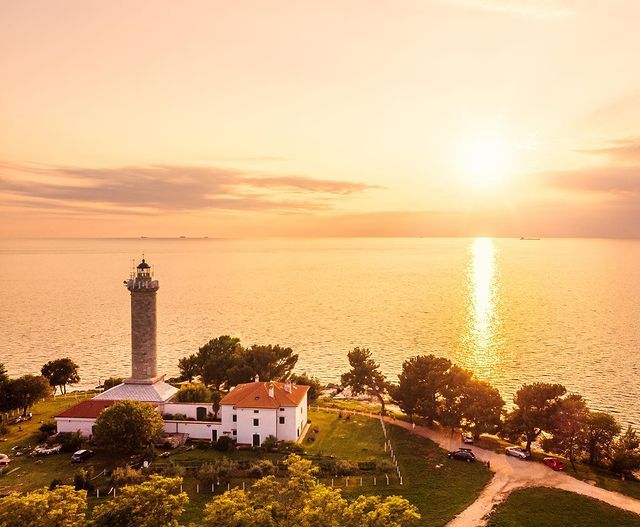
There’s a point where Istria simply runs out of land. The peninsula narrows, the road straightens, and you arrive at Savudrija — a scattering of stone houses, a handful of restaurants, and a lighthouse that has been standing watch over the Adriatic since before most of the region’s tourist towns existed. It’s Istria’s northernmost tip, and it feels like an ending and a beginning at once.
I come here when I need to remember what the coast was like before it became a product. Savudrija hasn’t been developed or branded or turned into a destination. It’s just a place where the land meets the sea, and that simplicity is exactly the point.
The Lighthouse
Savudrija’s lighthouse is the oldest working lighthouse on the Adriatic, built in 1818 by the Austrian Empire to guide ships through the shallow waters between Istria and the Italian coast. It stands thirty-six metres tall, painted in white and green stripes, and its light still sweeps across the sea every night, just as it has for more than two hundred years.
The story behind it adds a layer of romance that locals love to tell. Count Metternich, the Austrian chancellor, reportedly funded its construction not just for maritime safety but because his mistress lived nearby and he wanted a landmark to navigate by when visiting her by sea. Whether that’s history or legend depends on who’s telling the story, but either way, it’s a good one.
You can’t climb the lighthouse itself, but the area around its base is open and makes for one of the best sunset spots on the entire Istrian coast. The view stretches south along the rocky shoreline toward Umag and, on clear evenings, across the Gulf of Trieste to the Italian coast. There’s usually nobody here except a few fishermen and the occasional couple who’ve figured out the secret.
The Coast
Savudrija’s coastline is low and rocky — flat stone shelves that step down into water so clear you can see the bottom at five metres. It’s not a beach destination in the conventional sense; there’s no sand, no loungers, no beach bars with thumping music. What there is, instead, is some of the cleanest swimming on Istria’s western coast and a quietness that feels almost anachronistic in peak summer.
The rocks are smooth enough to lay a towel on, and the entry into the water is gradual — you can wade in from most points without scrambling. Sea urchins live here, so water shoes are advisable, but the snorkelling is excellent: small fish, octopus hiding in crevices, and the kind of underwater clarity that makes you forget you’re in the same sea that’s often murky further south. Families with young children will appreciate the calm, shallow pools that form between the rock shelves at low tide.
A coastal path runs along the shore in both directions — south toward Zambratija and north toward the Slovenian border at Sečovlje. Walking it in the early morning or late afternoon, with the light low over the water and the scent of pine and salt in the air, is one of those simple Istrian pleasures that no amount of money can improve upon.
Zambratija and the Oldest Boat in the Mediterranean
Just south of Savudrija lies Zambratija, a tiny settlement with an outsized archaeological claim: in the mud of its shallow bay, researchers discovered the remains of a sewn boat dating back over three thousand years, making it one of the oldest surviving watercraft in the Mediterranean. The find confirmed that this stretch of coast has been navigated since the Bronze Age — long before Romans, Venetians, or Austrian chancellors arrived.
Zambratija itself is barely a village — a small harbour, a restaurant or two, and a shoreline that curves gently around a quiet bay. But knowing that people were building boats and sailing from this exact spot three millennia ago gives the place a weight that its modest appearance doesn’t immediately suggest.
Where to Eat
Savudrija’s dining scene is small but surprisingly good. The handful of restaurants here rely on the day’s catch from the waters directly in front of them, and the cooking is straightforward coastal Istrian — grilled fish, seafood pasta, octopus salad, and plates of fresh shellfish served with local olive oil and bread.
Konoba Kažela, set back slightly from the coast on the road into Savudrija, is the kind of place that doesn’t need a website. Stone walls, a vine-covered terrace, handwritten specials, and fish that was in the sea hours ago. Their grilled orada (sea bream) is as good as anything on the coast, and the prices haven’t caught up with the restaurant’s reputation — yet.
For something more casual, the small spots right by the lighthouse area serve simple plates and cold beer — not destination dining, but exactly right when you’ve spent the afternoon swimming and don’t want to change out of your salt-stiffened clothes.
The Border Country
Savudrija sits in Istria’s far northwest corner, close enough to Slovenia that you can see the salt pans of Sečovlje from the shore. The border crossing at Plovanija is just a few minutes away, and the Slovenian coastal towns of Portorož and Piran are within easy day-trip distance. This gives Savudrija a particular character — it feels like a crossroads, a place where Croatian, Slovenian, and Italian influences have been mixing for centuries, long before the borders were drawn where they are now.
Umag, the nearest proper town, is about ten minutes south and has everything you might need — supermarkets, a marina, tennis courts that host an ATP tournament every summer, and a cluster of restaurants and bars around its attractive old town. But the beauty of staying in Savudrija is precisely that it isn’t Umag. It’s the quiet margin, the place you go to step away from even the modest bustle of a small Istrian town.
When to Come
Savudrija works in any season, but it’s at its most atmospheric outside of high summer. In May and June, the wildflowers are out along the coastal path, the water is warming up, and you’ll have the rocks to yourself. September and October bring softer light, warmer sea temperatures than you’d expect, and the kind of stillness that makes you want to stay longer than you planned. Even in winter, the lighthouse walk is worth the drive — the Adriatic in a winter storm, seen from this exposed point, is something you don’t forget.
Savudrija doesn’t try to compete with the more famous names along the Istrian coast, and that’s its great advantage. It’s a place for people who’ve already seen Rovinj and Poreč and are looking for something quieter, older, and closer to what this coastline has always been — rock, sea, light, and the steady sweep of a lighthouse beam that’s been guiding people home for two centuries.
Planning your Istrian adventure? Explore our Best Towns & Villages in Istria or browse Complete Istria Travel Guide.
 Istria.me
Leave a comment