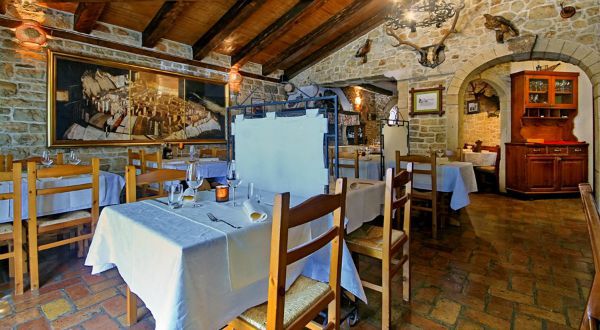
The word konoba originally meant a cellar — the cool underground room where Istrian families stored wine, cured meat, and preserved vegetables. Over centuries it evolved to mean something broader: a family-run tavern where the food is traditional, the portions are generous, and the atmosphere is whatever the owner decided it should be that day. Some konobas have tablecloths and candles. Others have plastic chairs and a handwritten menu on a chalkboard. The quality of the food correlates very poorly with the decor.
Finding a genuinely good konoba in Istria requires ignoring almost everything the tourist infrastructure tells you. The best places don’t advertise, don’t appear on the first page of any review platform, and are often difficult to find even when you know where you’re going. This guide is an attempt to narrow the search.
What Makes a Konoba Different
The distinction between a konoba and a restaurant in Istria is partly about formality and partly about philosophy. A konoba is typically family-run, often with the same family that’s been running it for two or three generations. The cook is usually the owner or a close relative. The menu changes with the season, the market, and the mood of the kitchen. There is no executive chef, no social media manager, no carefully curated Instagram presence. There is, usually, one person doing most of the work and caring a great deal about whether the food is good.
The dishes you’ll find at a proper konoba are the ones that have been eaten in Istria for centuries: maneštra, grilled fish, hand-rolled fuži with truffles or game, roast lamb, peka dishes. The ingredients are largely local — vegetables from the garden, olive oil from the family grove, wine from the barrel in the cellar. Prices are reasonable. Reservations are sometimes necessary, sometimes impossible because there’s no phone number listed anywhere.
Inland Konobas: The Heart of Traditional Cooking
Konoba Motovun Area
The villages around Motovun — Livade, Kaldir, Oprtalj, Brkac ̆ — are home to some of the best traditional cooking in Istria, driven by proximity to the truffle grounds and a farming culture that has kept local food traditions alive. Look for konobas that serve fixed menus rather than à la carte: when a kitchen is cooking one or two things that day and that’s what you’re getting, you’re almost always eating better food than somewhere trying to execute fifteen different dishes.
In this area, fuži with freshly grated truffle is the dish to order from September through January. Outside of truffle season, the wild boar ragù, the roast lamb, and the maneštra od bobića — the corn and bean soup that is Istrian comfort food in its purest form — are all worth seeking out.
Buzet Region
Buzet calls itself the City of Truffles, which gives you some indication of what the local kitchen prioritises. The konobas in the old town and in the villages below it (Roč, Hum, Vrh) are among the most traditional in Istria — stone interiors, wood-burning fires in winter, menus that lean heavily on local ingredients and old recipes. Jota — the sauerkraut and bean soup that is the regional winter staple — is particularly good in this area, where the northern Istrian influence from Trieste and Slovenia is strongest.
The peka dishes here are worth planning around. Octopus, lamb, or veal slow-cooked under the cast-iron bell require advance ordering — call ahead the day before and ask if they’re doing peka that week. When it’s available, it should be your first choice.
Grožnjan and the Hill Towns
Grožnjan is known primarily as an artist’s village, but the konobas that serve the small resident community are genuinely good. The views from the hilltop are extraordinary and the tourist crowds are lighter than at Motovun, which means the cooking hasn’t had to adapt to tourist preferences in the same way. The local olive oil is excellent — a drizzle over everything is both traditional and entirely justified.
Coastal Konobas: Where Fish Meets Tradition
Lim Fjord
The konobas lining the banks of the Lim Fjord are not hidden gems — locals and visitors alike know them — but they remain genuinely excellent for one specific purpose: mussels and oysters from the fjord’s own farms, eaten at a table ten metres from the water. The setting — narrow canyon, still green water, the occasional fishing boat — is as good as anywhere in Istria, and the shellfish, harvested that morning, are exceptional.
Order the mussels buzara-style and the oysters raw. Add a carafe of local Malvazija. Don’t order anything else unless you’re genuinely hungry after that, because you probably won’t be.
The Rovinj Backstreets
Rovinj is genuinely tourist-heavy, and a lot of its restaurant offer reflects that. But off the main promenade, in the narrower alleys of the old town and in the residential streets just outside the historic centre, there are konobas that have been feeding locals for decades. The tell is the clientele: if it’s entirely tourists, walk past. If you can see tables of locals in their sixties arguing about football, sit down immediately.
In Rovinj, the grilled fish and seafood are the main attraction. Scampi buzara, grilled branzino, black risotto — the quality at the better local konobas is meaningfully higher than at the tourist-facing restaurants, at prices that are often lower.
Novigrad
Novigrad punches well above its weight for seafood dining. This small fishing town on the northern coast has a handful of konobas and restaurants that are genuinely excellent, including some that have earned serious recognition from Croatian food media and international food journalists. The local specialty is scampi — the small, sweet Adriatic scampi from the channel between Istria and the Kvarner islands — served every way imaginable. The town is also significantly less crowded than Rovinj or Poreč, which means the cooking is less pressured and the service more attentive.
Agrotourism Konobas: The Fixed-Menu Experience
A separate category worth knowing about: agrotourism konobas, or agroturizmi, are farm-based operations licensed to serve food and wine to visitors. The format is almost always a fixed menu — you arrive, you eat what they made that day, you leave happy. No choices, no negotiation, occasionally no menu at all.
At their best, agrotourism konobas are the closest thing Istria offers to eating in a private home. The vegetables come from the garden outside. The olive oil is pressed on-site or from the neighbouring grove. The wine is from the family’s own vines. The cook has been making this food since childhood. The experience is unhurried, generous, and occasionally life-changing in the modest way that really excellent simple food can be.
Finding them requires local knowledge or a willingness to drive down unpaved roads following handmade signs. The reward is proportional to the effort.
How to Find a Good Konoba: Practical Rules
- Ask your accommodation host. Anyone running a small guesthouse or apartment rental in Istria knows where the good food is. Ask specifically for where they eat themselves, not where they send tourists.
- Avoid the main square. In every Istrian town, the restaurants on the main square or promenade are operating on tourist footfall. The best food is always one or two streets back.
- Look for cars parked outside at lunch. Locals drive to good konobas. A car park full of local plates at midday is a reliable positive signal.
- Shorter menus are usually better. A konoba that does five or six things well is preferable to one that does twenty things adequately. If the menu takes more than two minutes to read, that’s information.
- Go for lunch rather than dinner. The best traditional cooking in Istria happens at midday, which is when locals eat their main meal. Many konobas don’t serve dinner at all, or offer a reduced menu in the evening.
A Note on Reservations
Good konobas in Istria can be difficult to book. Some don’t have websites. Some don’t have listed phone numbers. Some are only open on certain days. Some will tell you they’re fully booked when they see an unfamiliar face, then seat locals who arrived after you.
The solution to most of these problems is to ask a local to make the reservation for you, or to be flexible about when and where you eat. Showing up at a konoba at 12:30 on a Tuesday in October, when the tourist season is over and the locals are back in their rhythms, is a different experience from showing up at 7pm on a Saturday in August. Both are valid. Only one of them is reliably excellent.
The food culture of Istria is one of its great and underappreciated pleasures. The peninsula has been producing exceptional ingredients for centuries, and the best konobas are the places that tradition is most alive. It takes a little effort to find them. It’s always worth it.
For the full picture of Istrian food and drink, explore our Istria Food & Wine Guide. And if you’re planning where to base yourself, the Complete Istria Travel Guide covers all the essentials.
 Istria.me
Leave a comment