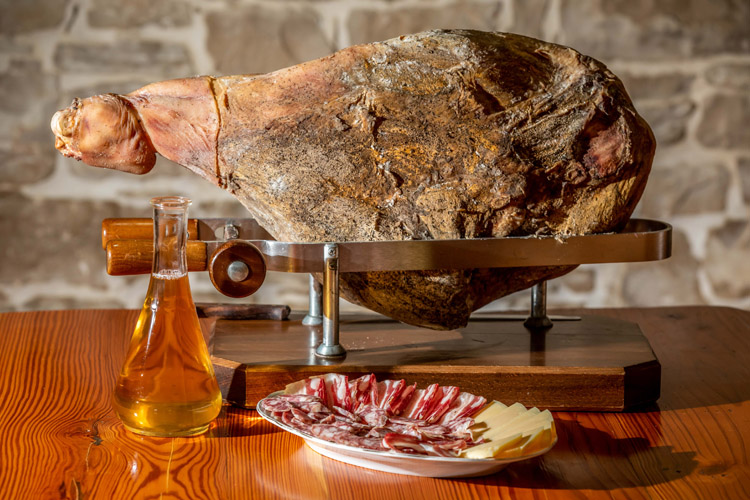
On the Istrian peninsula, there are two things the Bora wind is responsible for: the clarity of the winter sky and the quality of the prosciutto. The first is a meteorological fact. The second is something that Istrian cured meat producers will tell you with complete conviction, and after you’ve tasted the result, you’ll be inclined to believe them.
Istrian prosciutto — pršut in Croatian, prosciutto istriano in Italian — is a dry-cured ham with Protected Geographical Indication status and a production tradition that stretches back centuries. It is not the same as Parma ham, or San Daniele, or any other prosciutto. It is its own thing, shaped by the specific conditions of the peninsula, and it is excellent.
What Makes Istrian Prosciutto Different
The defining characteristic of Istrian prosciutto is that it is cured without a rind — the entire surface of the ham is exposed during curing, rather than just the cut face. This allows the salt, pepper, rosemary, and other aromatics rubbed into the surface to penetrate the meat from all sides, producing a more evenly seasoned product with a distinctive flavour that carries through every slice.
The second defining characteristic is the Bora. This cold, dry wind that blows from the northeast across the Karstic plateau and down onto the Istrian coast is, in effect, a natural curing agent. Its low humidity and consistent force draws moisture from the hanging hams steadily and evenly, producing a texture — firm but yielding, with no clammy dampness — that’s difficult to achieve in a controlled drying environment. Istrian producers will tell you that artificial climate control cannot replicate what the Bora does naturally. Based on the evidence, they’re probably right.
The Production Process
Salting and Seasoning
The hams — typically from large, well-fed pigs, with a minimum weight that ensures sufficient fat coverage — are first rubbed thoroughly with a mixture of sea salt, black pepper, rosemary, and sometimes garlic. The exact seasoning blend varies by producer and is often a closely held family recipe. The hams are then left in a salting room for several weeks, turned and re-rubbed periodically to ensure even penetration.
Unlike some prosciutto traditions, Istrian producers do not use nitrates or nitrites. The preservation is achieved entirely through salt, drying, and time. This gives the finished product a more natural colour — deeper and more varied than the uniform pink of industrially produced ham — and a flavour that has none of the faintly chemical aftertaste you can detect in some mass-produced prosciuttos.
Smoking
After salting, Istrian prosciutto is cold-smoked over a mixture of local hardwoods — typically oak, combined with aromatic herbs including laurel and rosemary. This is one of the features that most clearly distinguishes it from Italian prosciuttos, which are not smoked. The smoking adds a subtle depth to the flavour — not the assertive smokiness of a German or Hungarian ham, but a background note that you notice when the ham is thinly sliced and the full flavour develops on the palate.
Air Drying
The smoked hams are then hung in drying rooms — traditionally stone buildings with slatted windows designed to channel the Bora through — for a minimum of twelve months. The best Istrian prosciutto is aged for eighteen months to two years, during which time the ham loses roughly a third of its original weight in moisture, concentrating the flavour considerably.
During ageing, the exposed surface of the ham develops a protective coating of lard mixed with salt and pepper, applied periodically by hand. This prevents the surface from drying out too quickly while allowing the interior to continue losing moisture slowly. The result is a ham with an even, consistent texture throughout rather than a hard outer layer and a softer core.
How to Eat It
Istrian prosciutto should be sliced thinly — paper-thin, ideally, with the fat intact. The fat is not something to cut away; it carries much of the flavour and has a clean, slightly sweet quality from the aromatic curing that complements the lean meat beautifully. If someone is cutting your prosciutto too thick, that’s information about the establishment.
The classic Istrian serving is simply: prosciutto, local sheep’s cheese (ovčji sir), olives, and bread. Sometimes a few cornichons. Sometimes nothing else at all. This combination — the salt and smoke of the ham, the tangy richness of the cheese, the brine of the olives — is one of the great simple food experiences of the region, and it requires no elaboration.
In cooking, Istrian prosciutto appears in pasta dishes — wrapped around fuži, stirred into risotto, layered into a sauce with mushrooms and cream — and as a wrapping for everything from figs to asparagus. Its smoky depth makes it more versatile in cooked applications than most Italian prosciuttos, which can turn bitter when heated. Istrian prosciutto holds its character when warm.
The Protected Geographical Indication
Istrian prosciutto received PGI (Protected Geographical Indication) status from the European Union, which means that only ham produced according to traditional methods within the defined Istrian production area can be labelled and sold as Istarski pršut. This protection matters: it guarantees that what you’re buying is genuinely the traditional product, made the traditional way, and not an industrial approximation. Look for the official PGI certification mark on packaging when buying.
Where to Buy the Best Istrian Prosciutto
Tinjan
The inland village of Tinjan is considered the heartland of Istrian prosciutto production and hosts an annual prosciutto festival in September that draws serious food enthusiasts from across Europe. Several of the most respected producers are based here or in the surrounding villages. Visiting during the festival gives you access to multiple producers in one place, with tastings and direct purchasing. Outside of festival season, many producers welcome visitors by appointment.
Pazin and Central Istria
The inland areas around Pazin and Grožnjan are also strong prosciutto country. Producers in these areas tend to be smaller and less commercially oriented than those around Tinjan, which can mean more variation in style and occasionally exceptional quality from producers who haven’t been noticed by food journalists yet. Asking around in the villages is the most reliable way to find them.
Markets and Specialty Shops
The Pula market has excellent prosciutto vendors who sell both whole legs and sliced product by weight. The advantage of buying from a market stall over a supermarket is that you can taste before you buy and ask questions about the producer and ageing time. The Rovinj and Poreč markets are also good sources.
Specialist delicatessens in the larger towns stock a curated selection of the better producers, often including some that don’t sell through other channels. These shops are worth seeking out, particularly if you want to compare several producers side by side.
Buying a Whole Leg
If you’re serious about Istrian prosciutto, buying a whole leg direct from a producer is both economical and deeply satisfying. A whole leg, vacuum-packed, can be taken home as checked luggage without issue. The investment is repaid over months of use, and having a whole Istrian pršut hanging in your kitchen (or more practically, stored in a cool pantry) is one of the more civilised things you can do after a trip to the peninsula.
Ask the producer how long the leg has been aged and whether it’s ready to carve immediately or needs further resting. Most will give you honest advice, since their reputation is on the line with every leg they sell.
Prosciutto and Wine: The Essential Pairing
Istrian prosciutto and Istrian wine were made for each other, which makes geographic sense — they come from the same soil, shaped by the same climate, and have been eaten together for centuries. The classic pairing is with Malvazija Istarska: the wine’s mineral acidity and gentle fruitiness cut through the fat of the ham and refresh the palate between bites. A glass of Malvazija and a plate of prosciutto with sheep’s cheese on a warm evening somewhere overlooking the Adriatic is as close to a perfect thing as food and drink gets.
Teran, the local red, also works well — particularly with prosciutto that has a longer ageing time and more concentrated flavour. The wine’s high acidity and tannin are a natural counterpoint to the richness of the cured meat.
Istrian prosciutto is, ultimately, a product of place. The specific salt of the curing, the particular aromatic herbs that grow on this limestone peninsula, the cold Bora wind that has been drying these hams for centuries — all of it comes together in something that genuinely cannot be replicated elsewhere. That’s a rare thing in food, and worth appreciating every time you taste it.
Prosciutto is just one highlight of Istria’s extraordinary food culture. Explore more in our Istria Food & Wine Guide, or read about the konobas where it’s eaten at its best.
 Istria.me
Leave a comment