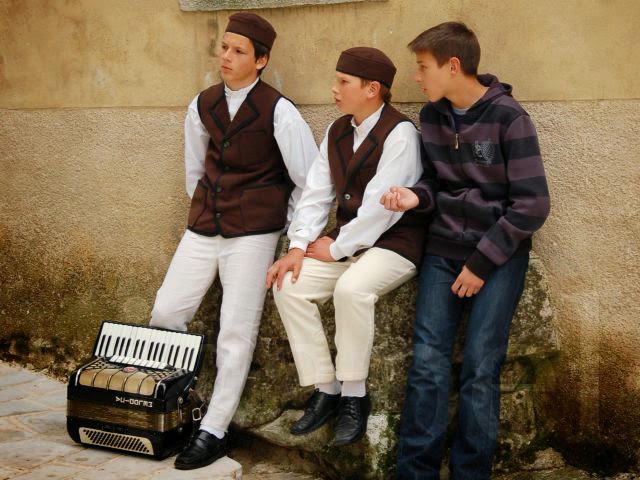
If you sit long enough at a corner table in any konoba from Buzet to Bale, you’ll eventually hear a conversation that sounds like a collision between Italian musicality, Slavic consonants, and something entirely older. Welcome to the Istrian dialect.
When visitors arrive on our peninsula, they often expect to hear standard Croatian. Instead, they’re met with a linguistic stew that has simmered for centuries. We don’t just speak a language here; we speak our history. It’s an auditory map of every empire, republic, and kingdom that has ever claimed a piece of this limestone wedge in the Adriatic.
A Collision of Empires
To understand how we speak, you have to understand who has marched through our best towns and villages over the last two millennia. The base layer is Chakavian, one of the oldest dialects of the Croatian language. But on top of that, history has aggressively layered Venetian Italian, Austrian German, and the remnants of indigenous pre-Roman tongues.
This means our everyday vocabulary is wildly pragmatic. We use Italian words for tools and sailing, German words for bureaucracy and administration, and ancient Slavic words for the land and the weather. If an Istrian grandfather is fixing a boat, half his sentences would be perfectly understood in Venice. If he’s complaining about taxes, he’s probably using words left over from the Austro-Hungarian Empire.
The Italian Connection
The Venetian Republic ruled the coastal areas of Istria for over 500 years, and they left a permanent mark on how we communicate. Along the coast, especially in places like Rovinj and Novigrad, the Venetian dialect is still spoken natively by the Italian minority. But even for the Croatian majority, the crossover is absolute.
When we sit down to a meal—perhaps exploring some of the delicacies found in our Food & Wine Guide—the culinary vocabulary is almost entirely Italian-derived. We eat pašta (pasta), drink from a bocal (pitcher), and use a pirun (fork) instead of the standard Croatian vilica. The rhythm of our speech, the expressive hand gestures, the loud exclamations over a good plate of seafood—it’s an Adriatic operating system running on a Slavic hard drive.
The Secret Languages of the Peninsula
Beyond the broad Istrian dialect, our peninsula hides linguistic pockets that baffle even the most educated linguists. In the southwest corner, a handful of elderly residents still speak Istriot, a Romance language that predates the Venetian arrival and is now critically endangered.
Meanwhile, in a few remote villages near the Učka mountain—which you can read more about in our Ultimate Activity Guide—you’ll find speakers of Istro-Romanian. It’s a completely different language brought here by shepherds migrating from the Balkans hundreds of years ago. To hear these languages spoken today is to hear ghosts conversing in the modern world.
Speaking Like a Local
You don’t need to learn our dialect to visit, but knowing a few quirks will earn you a nod of respect from the waiter pouring your Malvazija. The most important thing to know is that we shorten everything. We drop the ends of words, swallow vowels, and speak with a melodic lilt that sets us apart from the rest of Croatia.
If someone asks how you are, you don’t need a complicated answer. A simple pomalo—which translates roughly to “slowly” or “take it easy”—is the ultimate Istrian philosophy wrapped in a single word.
Our dialect isn’t just a way to order coffee or buy fish at the morning market. It’s the connective tissue of our culture, a daily reminder that Istria has always been a crossroads of the Mediterranean and Central Europe. It’s a linguistic stew that has simmered for centuries, and frankly, we wouldn’t have it any other way.
 Istria.me