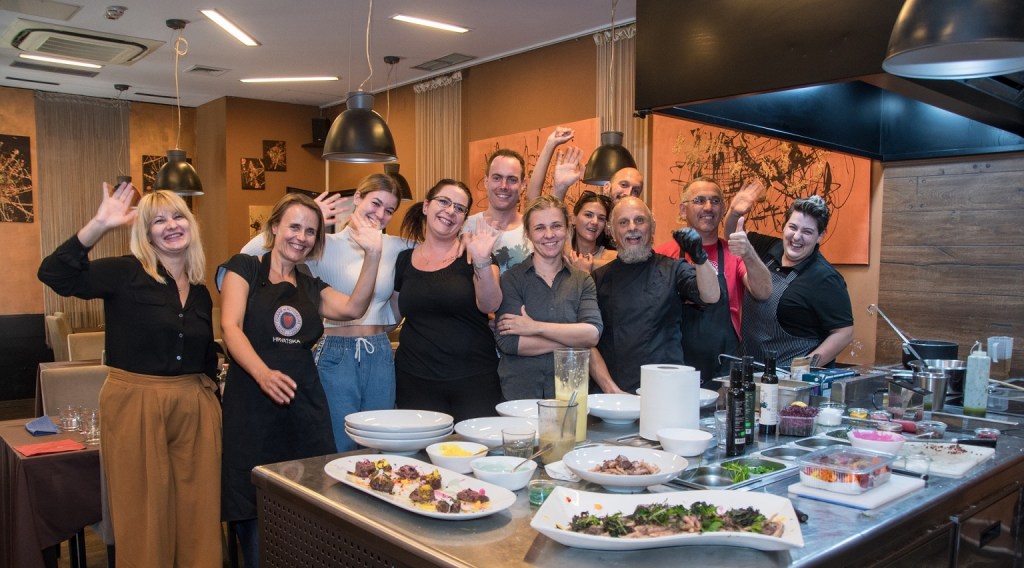
You can eat very well in Istria without understanding much about how the food is made. But something shifts when you’ve rolled fuži by hand for the first time, or stood over a pan watching eggs slowly fold around wild asparagus, or pressed your thumb into a ball of dough and been told, firmly but kindly, that you’re doing it wrong. Cooking classes in Istria aren’t a tourist activity bolted onto the food scene — the best ones are a direct line into how people here actually cook, and what you learn tends to stay with you long after the meal is over.
What Makes an Istrian Cooking Class Worth Doing
The question to ask before booking anything is: who is teaching, and where does the food come from? A class run by a professional chef in a purpose-built demonstration kitchen can be enjoyable, but it’s a different experience from learning to make maneštra from a farmer’s wife who has been cooking it every winter for forty years and has never consulted a recipe. Both have value, but only one of them is teaching you something that couldn’t have been learned anywhere else.
The best Istrian cooking experiences are rooted in homes, farms, and family kitchens. They tend to be small — six to ten people at most — and focused on a specific tradition or season rather than a generic greatest-hits menu. They use ingredients from the property or the local market. And they include eating what you’ve cooked, usually at the same table where you cooked it, with wine that was made nearby.
Pasta: The Essential Starting Point
If you’re going to learn one thing about Istrian cooking, make it pasta. Fuži and pljukanci are the two shapes at the heart of the tradition, and both are made by hand from an egg dough that’s simple in its ingredients and demanding in its technique. Fuži — the rolled quill shape formed around a wooden stick — requires a particular wrist motion that looks straightforward and isn’t. Pljukanci — the thicker, hand-rolled rope — is more forgiving but still takes practice to get even.
Most cooking classes that include pasta making will teach you the dough first: how much egg to flour, how long to knead, when the dough is ready. Then the shaping, which takes the rest of the class. Then a sauce — often a truffle sauce in autumn, a wild asparagus and egg preparation in spring, or a slow-cooked meat ragú that’s been cooking since morning. You eat what you make, and the combination of effort and hunger makes it taste better than it probably would in a restaurant. This is one of cooking’s reliable tricks.
Truffle Cooking: When and What to Expect
Autumn cooking classes built around truffles are among the most popular experiences in Istria, and for good reason — the truffle season brings an ingredient that’s difficult and expensive to work with at home, and learning to use it properly in its natural context is genuinely valuable. The best truffle cooking classes are offered by operators who also do truffle hunting, which means the class sometimes begins in the forest with a dog and ends in the kitchen with what was found that morning. That continuity — from ground to plate — is rare and memorable.
In the kitchen, the key lesson with truffles is restraint: how little heat is needed, how the fat in egg or butter or olive oil carries the aroma, why you grate or shave rather than chop. A good truffle class teaches you that less really is more, and that the most common mistake people make at home is overwhelming the truffle with competing flavours. You leave understanding why a simple truffle omelette, made correctly, costs as much as it does at a restaurant — and how to make one yourself.
Seasonal and Foraged Ingredients
Some of the most interesting cooking classes in Istria are built entirely around seasonal availability. In spring, this means wild asparagus — perhaps with a morning forage followed by an afternoon cooking session where the šparoge you picked become fritaja, pasta, and risotto. In summer, classes focused on preserving — making the tomato sauces and pickled vegetables that Istrian families put up for winter — offer a window into how the food culture here operates beyond the tourist season.
The olive harvest in November is another peak moment. A few producers combine harvest participation with an oil-tasting and cooking session, where you press olives in the morning and spend the afternoon learning how to cook with fresh-pressed oil — its flavour profile is so different from bottled oil that it changes how you approach the basics of Istrian cooking. Grilling, dressing, finishing — fresh oil behaves differently and rewards different instincts.
Bread, Pastry, and the Sweet Side
Not every class has to be about the savoury canon. Istria has a baking tradition that’s less documented but equally worth learning: the olive oil flatbreads cooked directly on the hearth, the walnut rolls that appear at harvest celebrations, and the fried pastries — fritule and kroštule — that are easier to eat than to make correctly. A class focused on traditional Istrian baking and pastry is a gentler entry point than one built around truffles or pasta technique, and the results travel well — the skills come home with you in a way that a meal doesn’t.
Honey and cheese tasting sessions sometimes run alongside baking classes, which makes for a well-rounded half-day: you bake in the morning, then eat what you’ve made alongside a guided tasting of local honeys and cheeses, all paired with a glass of Muškat Momjanski. It’s a format that suits people who want to learn about the food without committing to four hours of active cooking.
How to Find a Good Class
The same principle that applies to finding a good agriturismo applies here: local recommendation beats booking platforms. Ask at your accommodation, ask at the market, ask the person selling you cheese if they know anyone who teaches cooking. The best classes don’t advertise aggressively because they don’t need to — word of mouth keeps them full.
That said, a few operators have built enough of a reputation that they’re findable online. When evaluating what’s available, look for classes that specify local and seasonal ingredients, that are capped at a small number of participants, and where the person teaching is described as a home cook, farmer, or food producer rather than a chef. Professional credentials are less relevant here than genuine knowledge of the tradition.
Timing matters too. If you want to cook with truffles, come in autumn — September through December for black, October and November for white. For wild asparagus, late February to early April. For the olive harvest experience, November. Plan the cooking class before you plan the rest of the itinerary, because the seasonal ingredient should drive the visit, not the other way around.
What You Actually Take Home
The practical outcome of a good Istrian cooking class is a small set of techniques that transfer directly to your kitchen at home: how to make egg pasta dough, how to use truffle minimally and effectively, how to cook asparagus without losing its character, how to dress a dish with good olive oil at the end rather than cooking with it throughout. None of these require Istrian ingredients to be useful. They’re principles that work wherever you cook.
But the less tangible thing you take home is harder to name. It’s something about understanding food as a system — connected to soil, season, and the people who work both. Istrian cooking isn’t complicated, but it has a logic and a coherence that becomes visible when you learn it from someone who lives inside it. That’s what a class here can give you that a cookbook or a YouTube video can’t. The recipe is almost secondary.
 Istria.me
Leave a comment