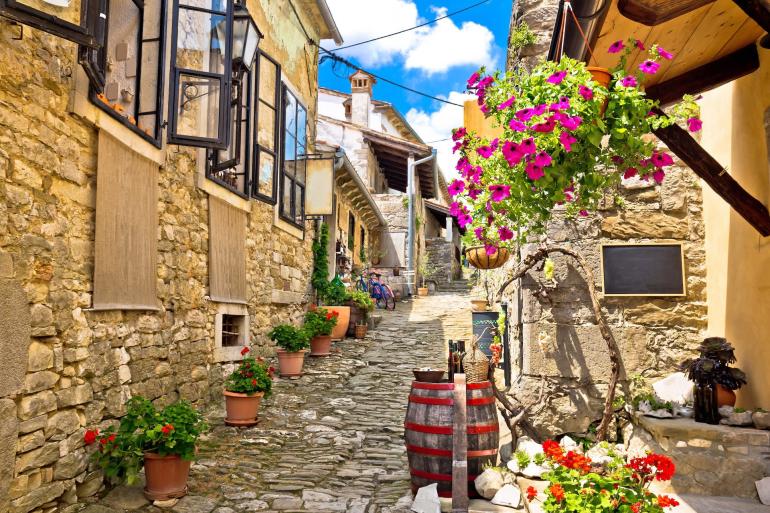
When we talk about Istria’s soul, we’re not talking about any single place. We’re talking about the tapestry of towns and villages that make this peninsula so impossibly charming. Whether you’re drawn to the azure waters of the Adriatic, the rolling green hills of the interior, or the weathered stone of ancient inland settlements, Istria offers something that feels deeply authentic—a place where the past isn’t just preserved, it’s lived.
We often think of Istrian geography in three acts. There’s the Blue Istria of our coast—where fishermen still mend nets and medieval towns tumble down to pebbly beaches. There’s the Green Istria of our hilltops—where truffles grow in secret groves and artists have made their homes in centuries-old stone villages. And there’s the Grey Istria of our inland heartland—where massive amphitheatres stand as monuments to Rome, and caves plunge deep into the earth. Each tells its own story. Each is worth your time.
Table of Contents
- The Coastal Towns
- The Hilltop Villages
- The Inland Towns
- How to Choose Your Base
- Day Trip Combinations
- Off the Beaten Path
The Coastal Towns: Where the Adriatic Whispers
The coast is where most visitors first fall in love with Istria. Here, medieval towns cling to rocky promontories, their narrow lanes designed for foot traffic and afternoon strolls, their harbours still serving fishermen and pleasure boats in equal measure. The water here is impossibly clear—you can see ten metres down on a good day—and the light does things to stone and sea that make you understand why painters have been coming here for centuries.
Rovinj: The Jewel of the Adriatic
Rovinj is the town you’ve seen in a thousand travel magazines, and for good reason. This isn’t a secret anymore—the cat’s out of the bag. But here’s what matters: it deserves every bit of its fame. The town spirals up a hillside in a riot of terracotta roofs and pastel facades, each building seemingly stacked on top of the last. At the apex sits the Church of St. Euphemia, its bell tower visible from every vantage point in town, a needle pointing skyward over the Adriatic.
Walk the narrow streets in early morning or late evening, and you’ll understand the magic. The artist community here is genuine—not touristy—with galleries tucked into old stone buildings, painters working in studios with sea breezes flowing through open windows. The waterfront is lined with restaurants that serve the catch of the day because the boats literally bring it in metres away. We recommend the sunset aperitivo ritual here: find a stone ledge near the water, order a local wine, and watch the light turn the town golden.
Poreč: The Roman Past Made Beautiful
Poreč is a town that wears its 2,000 years lightly. Built on the foundations of a Roman settlement, the town centre still follows the ancient grid of Decumanus and Cardo—the main roads of any Roman town. But what makes Poreč special is the Basilica of Euphrasius, a UNESCO World Heritage site that manages to be both historically staggering and genuinely beautiful. The mosaics inside—particularly those golden Byzantine figures—stop you in your tracks.
The town beach scene is more lively here than in Rovinj, with a longer waterfront promenade, but the old town retains its medieval character. Stay for the evening passeggiata, that quintessentially Italian (but very Istrian) custom of strolling through the town square as the sun sets. The porches overlooking the main plaza fill with locals and visitors alike, nursing coffee or wine, watching life unfold. This is where you’ll feel Istria’s dual heritage—the Italian elegance meeting Central European practicality.
Pula: Where Rome Still Stands
Pula is different. It’s bigger, brasher, more industrial. It’s a real city, not a postcard village. And that’s precisely why you should come. The Pula Amphitheatre is one of the best-preserved Roman arenas outside Italy—six storeys of stone that once held 23,000 gladiatorial spectators, now offering views across the peninsula from its upper tiers. Stand in that arena on a quiet morning and the weight of history is tangible. You’re standing in the same spot where life-and-death combat unfolded nearly 2,000 years ago.
Beyond the amphitheatre, Pula has archaeological museums that are genuinely world-class, a vibrant food market that’s been operating for centuries, and a gritty working-waterfront charm that feels honest. The city isn’t trying to be cute—it’s trying to be itself. That authenticity is refreshing. Come for the Roman ruins, stay for the local restaurants where fishermen’s families still eat lunch, where the wine list is hand-written, and where you’re the only tourist at the table.
Novigrad: The Underrated Gem
Novigrad sits between Rovinj and Poreč on the map, but somehow stays out of the spotlight. That’s changing slowly, and we’re of two minds about it. On one hand, Novigrad deserves recognition—it’s genuinely lovely, with a working waterfront that feels completely authentic. Fishing boats unload at dawn, locals gather at the morning market, and by evening the restaurants fill with families, not tour groups.
The old town is compact and walkable, with a Byzantine church that’s unexpectedly moving. The beaches here are less crowded than Rovinj, the prices are lower, and the pace feels slower. If you want a coastal experience that hasn’t been packaged and polished for tourism, Novigrad is where you’ll find it. We think of it as the thinking person’s alternative to the big three.
Umag: Northern Charm
Umag is further north, where the coast starts to feel more Mediterranean and less Adriatic. The town has a small but perfectly formed old quarter, a decent stretch of beach, and a deserved reputation for its early-season warmth—the northernmost Istrian coast catches more sun than you’d expect. The main street is lined with cafés and restaurants that cater to both locals and tourists, but the ratio still favors residents, which is how we like it.
What makes Umag special is its sense of being a working town that happens to be beautiful, rather than a beautiful town trying to work. The evening market is lively, the waterfront is genuine, and the surrounding countryside—rolling hills of vineyards and olive groves—is some of Istria’s most picturesque. Come here to decompress, to eat well, and to understand what the Istrian coast feels like when you’re not fighting for restaurant seating.
Vrsar: The Sculptor’s Town
Vrsar is where artists come to think. Perched on a small peninsula with the remarkable Lim Fjord stretching inland behind it, Vrsar has become known for its sculpture parks and art installations. The town itself is intimate—maybe 600 permanent residents—with narrow medieval lanes that open suddenly onto views of the Adriatic. Read our full guide to Vrsar to discover how this quiet town became a gallery under the sky, and why the Lim Fjord is one of Europe’s most underrated natural wonders.
Rabac: The Pearl of Kvarner Bay
Rabac sits at the southern edge of Istria, where the peninsula meets the larger Kvarner Bay. It’s a beach town with real character—a place where tourism happened, yes, but where fishing and family life still matter. The pebble beach is longer than Rovinj’s, the waterfront is lined with local restaurants, and the pace is refreshingly slower. Our complete Rabac guide explains why this is where many Istrians come to actually relax, not to be seen.
Fažana: Gateway to the Brijuni Islands
Fažana is small—wonderfully small—but perfectly positioned as the departure point for the Brijuni Islands, one of Istria’s true treasures. This quiet fishing village has been revitalized in recent years, with galleries and restaurants moving in alongside the working fishermen. The main reason to come here is the islands, but the town itself is charming and merits a meal and an evening stroll. See our full Fažana guide for details on ferries, accommodation, and why the islands are unlike anything else you’ll see in the Mediterranean.
Savudrija: The Northernmost Point
Savudrija is where Istria ends and the rest of the world begins—the northernmost point of the peninsula, marked by a lighthouse that’s been guiding boats since 1818. This is an outlier’s destination, quiet and windswept, with dramatic coastal scenery and a sense of being at the edge of things. Our Savudrija guide covers the hikes, the lighthouse visit, and why some of the best seafood restaurants in Istria serve their catch with a view of nothing but sea and sky.
The Hilltop Villages: Truffles, Wine, and Timeless Stone
Move inland and upward, and Istria transforms. The coast’s azure gives way to green—emerald forests, olive groves, vineyards clinging to hillsides. The towns here are older, often built on hilltops for medieval defense, and they’ve aged into something profound. These aren’t picture-perfect restored villages. Many are still very much lived-in, with families who’ve been here for generations, with restaurants run by people who know every customer by name.
Motovun: The Film Festival Town in the Clouds
Motovun sits on a hilltop so dramatically positioned that it feels like someone placed it there for effect. The town is surrounded by medieval walls that you can walk—a circuit that takes maybe 30 minutes and offers views across the Mirna Valley that are almost absurd in their beauty. The main attraction is the Motovun Film Festival, held every summer, which brings art cinema and a cosmopolitan crowd to this otherwise sleepy village. But even without the festival, Motovun is worth the drive.
This is truffle territory. The Mirna Valley below Motovun is some of Europe’s most productive truffle ground—white truffles in autumn, black truffles year-round. Several restaurants in town serve truffle-focused menus. The local wine—especially the indigenous Teran and the white Vitovska—pairs beautifully with truffle dishes. Stay in one of the small family-run hotels, wake to mist rolling through the valley below, and understand why people fall in love with Istria’s interior.
Grožnjan: The Artist’s Village
Grožnjan is Motovun’s artistic cousin. This village emptied out in the 1960s—young people left for cities, for opportunities, for a different life. Then artists arrived, and slowly the village refilled. Now it’s a working artist community in a way that feels organic and lived-in. Galleries line the lanes, but they’re real galleries with real artists, not tourist shops selling trinkets. Many artists actually live and work here, and you can watch them through open windows as you wander the stone streets.
The view from Grožnjan is panoramic—on clear days you can see all the way to the Adriatic. The restaurants are simple but genuine. The accommodation is in family homes converted into guesthouses. This is where you come to slow down, to spend an afternoon sitting in a café watching the light change, to talk to artists about their work, to remember why you travel in the first place. Grožnjan feels like a secret even though plenty of people know about it—but most of them rush through. Stay longer.
Hum: The World’s Smallest Town
Hum claims to be the world’s smallest town, a designation that’s more poetic than official but feels true when you’re walking its single main street. Maybe a dozen permanent residents call Hum home, but it’s a proper town—it has a church dating back to the 11th century, a small museum, and a café where locals and visitors gather. The stone buildings are incredibly preserved, untouched by modern development, which gives Hum a museum-piece quality without feeling like a museum.
What makes Hum special is its Glagolitic heritage. The Glagolitic script—the ancient Slavic alphabet—was used extensively in Istria, and Hum sits at the center of a circuit called the “Glagolitic Valley” where you can see this ancient writing carved into stone monuments. The town is also famous for its Hum-ska Biska, a local brandy made from mistletoe that’s been produced here since the 17th century. You can’t leave Hum without trying it—it’s stronger than it tastes, a fair warning.
Buzet: The City of Truffles
Buzet is the commercial heart of Istria’s truffle country. While Motovun and other villages are more atmospheric, Buzet is more practical—it’s a larger town where you’ll find truffle shops, truffle restaurants, and locals who live and breathe the truffle business. The annual Truffle Festival (usually in November) draws thousands of visitors. But even outside the festival, Buzet is worth a stop.
The town has an old quarter with views across the Mirna Valley, and several excellent restaurants dedicated to the local specialty. If you want to buy genuine Istrian truffles, truffle oil, or truffle products, Buzet is where you do it—prices are fair, and the shopkeepers know their product. The surrounding countryside is beautiful, with opportunities for hikes through truffle-hunting territory (though you’ll need permission from landowners). Buzet is where you’ll understand that truffles aren’t a luxury ingredient here—they’re a way of life.
Oprtalj: The Quiet Alternative
Oprtalj is what you get when you take Motovun or Grožnjan and subtract the tourism. This hilltop village is genuinely quiet, with maybe 200 permanent residents. The old town is compact—you can walk the whole thing in ten minutes—but it’s completely unspoiled. Medieval walls still partially stand, the church is genuinely old, and the restaurant at the top of the village serves food made by someone’s grandmother, we’re pretty sure.
Views from Oprtalj are spectacular—rolling green hills in every direction. This is hiking country, cycling country, the kind of place where you’re more likely to encounter cows than cameras. Come here if you want to experience an authentic Istrian village without any tourism infrastructure. Bring a picnic, climb the hill, enjoy the quiet, and remember what it feels like to be away from the crowds.
Bale: The Wine Village
Bale sits on its own hilltop in the central peninsula, surrounded by vineyards and olive groves. The town is small—maybe 1,500 residents—but it punches above its weight as a wine destination. Several excellent local wine producers are based here, and several restaurants focus on wine pairings and local food. The wines of Bale are particular—mineral, elegant, reflective of the soil and climate of this specific place.
The old town is charming in an understated way, with narrow lanes and stone buildings that have hosted families for centuries. The Church of the Nativity of Mary has a distinctive campanile (bell tower) that’s visible from across the valley. Stay here to do wine tastings, to hike through the surrounding countryside, and to understand why Bale has become a destination for wine lovers who want authenticity over tourism infrastructure.
Roč: The Glagolitic Centre
Roč is tiny—barely more than a hamlet—but it’s the epicenter of Glagolitic heritage in Istria. The Glagolitic script, the ancient Slavic alphabet, was preserved and used in Istria longer than anywhere else in the world. Roč has become a center for Glagolitic studies, with signs, plaques, and monuments throughout the village dedicated to this unique script. The church has a remarkable Glagolitic inscription, and the museum is genuinely fascinating if you’re interested in medieval Slavic culture.
The Roč-Hum circuit, combining these two tiny towns and following the “Glagolitic Trail,” is one of Istria’s most unique drives. You’ll see stone monuments carved with Glagolitic script in villages, forests, and fields. It’s a journey through living history, through a script that almost died but was stubbornly kept alive in this remote corner of Europe. Visit Roč as part of this larger journey—it’s small enough that you’ll see everything in an hour, but significant enough to change how you see Istrian heritage.
Momjan: Wine Dreams in Stone
Momjan sits on an isolated hilltop in central Istria, surrounded by some of the peninsula’s most celebrated vineyards. The village itself is tiny, but it’s become a destination for serious wine enthusiasts. Several boutique wineries operate from stone cellars in and around town. The wines—particularly the Teran and Malvazija varieties—are expressions of terroir that you can’t get anywhere else. Our complete Momjan guide covers the wineries, the gastronomy, and why this quiet village has become essential for wine lovers.
Livade: The World Capital of Truffles
Livade is the capital of the truffle world—if the truffle world has a capital, it’s here. This tiny village in the Motovun Forest is surrounded by the most productive truffle grounds on Earth. The Restaurant Zigante is based here, famous for serving truffle meals and for breaking world records with gigantic white truffles. Even if you’re not planning to spend €200 on a truffle-focused tasting menu, Livade is worth the drive just to understand why truffles matter so much here. Read our full Livade guide for everything you need to know about the truffle capital.
The Inland Towns: History Written in Stone
Further inland, the character changes again. These are towns that have grown around practical purposes—markets, administration, defense—rather than coastal tourism. They’re older, in some ways rawer, with less polish but more authenticity. They’re where you’ll find Istrian history at its deepest.
Pazin: The Heart of Istria
Pazin is Istria’s geographic and administrative heart. The town is built around a dramatic chasm—a massive sinkhole that drops over 100 metres—which captures rainwater and underground streams. In the 19th century, Jules Verne was so intrigued by this chasm that he featured it in his novel “Mathias Sandorf,” creating a romantic legend that still attracts visitors. The actual Pazin Chasm is less mysteriously dramatic than Verne imagined, but standing at the edge and looking down into that void is genuinely striking.
Beyond the chasm, Pazin is a working town with a restored medieval castle, multiple museums, and an excellent restaurant scene. The castle houses exhibitions about Istrian life and culture. The town feels real—locals shop here, kids go to school here, people live their lives. This is what Istrian towns feel like when they’re not trying to attract tourists. It’s refreshing, and the lack of tourist crowds makes it actually easier to explore and appreciate the place.
Vodnjan: The Town of Mummies
Vodnjan claims to be the largest Istrian village (though technically it’s a town by population, around 2,500 residents). Its main claim to fame is unusual: the Church of St. Blaise houses a remarkable collection of mummified bodies dating back centuries. These aren’t archaeological exhibits—they’re intentional mummifications, created centuries ago by monks who understood the conditions necessary for preservation. The bodies are on display, and they’re genuinely unsettling in a way that brings home the reality of medieval life and death.
Beyond the mummies, Vodnjan is a charming agricultural town with a real main square where locals gather, decent restaurants, and several other churches worth seeing. The surrounding countryside is rolling farmland dotted with olive groves and vineyards. This is where you get a sense of Istria’s agricultural heart—this is the real economy that supports the coast, the land that feeds the peninsula.
Labin: The Mining Town with a Soul
Labin sits on a hillside above Rabac on the southern coast. Historically, this was a coal mining town—the mines are closed now, but the town’s identity is still shaped by that industrial past. What makes Labin interesting is how it’s transformed that history. The old mining infrastructure is being adapted for tourism, with mine tours available that take you underground to understand what it meant to work in those conditions.
Beyond the mines, Labin has a genuinely charming old town with stone architecture, narrow lanes, and views down to the coast. There’s an excellent gallery dedicated to local history and art. The restaurants serve hearty, unpretentious food. This is a town that doesn’t have to try—it’s authentic because authenticity is all it knows. It’s particularly worth visiting if you’re staying in Rabac and want to add some depth to your coastal experience.
How to Choose Your Base: Coastal vs. Hilltop vs. Inland
One of the decisions you’ll face when planning an Istrian trip is where to stay. The choice really comes down to what kind of experience you’re after.
Choose Coastal if You Want:
- Swimming and beaches — The water is clear, warm (in season), and inviting. Rovinj, Poreč, and Rabac all have excellent coastal access.
- Seafood-focused dining — Waterfront restaurants with catches that arrived hours before your plate.
- Evening promenades — The sunset ritual of strolling with locals and tourists alike, watching the light turn gold.
- Easy logistics — Better public transportation, more restaurants, more accommodation options.
- International atmosphere — You’ll meet travelers from everywhere; the vibe is cosmopolitan.
Best bases: Rovinj for the atmosphere, Poreč for the history, Rabac if you want quieter beaches, Novigrad if you want authenticity without crowds.
Choose Hilltop if You Want:
- Truffles and wine — These are the landscapes where Istria’s most celebrated products grow.
- Panoramic views — The vistas from Motovun, Grožnjan, and similar villages are genuinely breathtaking.
- Quiet and nature — Forests, rolling hills, the sounds of real Istrian countryside.
- Authentic villages — Less tourism infrastructure means more genuine local life.
- Hiking and cycling — The roads and trails through these areas are spectacular.
Best bases: Motovun for the views and food, Grožnjan if you want an art community vibe, Buzet if you’re serious about truffles, Bale if you’re focused on wine.
Choose Inland if You Want:
- Deep history — Roman amphitheatres, medieval castles, ancient churches.
- Fewer tourists — The further you get from the coast, the more real the experience becomes.
- Agricultural authenticity — Olive groves, vineyards, farmland that’s actually farmed by real people.
- Value — Accommodation and food are noticeably cheaper than on the coast.
- A slower pace — Inland towns invite lingering, sitting, observing.
Best bases: Pazin for central location and history, Vodnjan for agricultural character, Labin if you want industrial heritage alongside coastal proximity.
Day Trip Combinations: The Best Town Pairings for Multi-Day Itineraries
Istria is small enough that you can pair towns for day trips, and the combinations create different narratives. Here are our favorite combinations:
The Coast-to-Hilltop Loop (Day 1-2)
Start in Rovinj, spend the morning exploring the old town and the waterfront. Lunch at a waterfront restaurant with a view of the sea. In the afternoon, drive inland to Motovun (45 minutes), climb to the top of the town, walk the medieval walls, and watch the sunset from the highest point. Dinner in Motovun with local wine and truffle-focused food. The next morning, hike through the Mirna Valley, stop in Livade for truffle shopping, then return to Rovinj via a different route to catch the afternoon light in Grožnjan.
The Truffle Trail (Day 1)
Start in Buzet, visit a truffle shop to understand the product. Drive to Livade, have lunch at a truffle-focused restaurant. Afternoon truffle hunting walk (with a guide). Visit Motovun for the evening. This is a full immersion in Istrian truffles—from the forest floor to the plate to understanding why this ingredient is so revered here.
The Wine Lover’s Circuit (Day 2-3)
Base yourself in Momjan or Bale. Spend one day doing wine tastings at local wineries—these are typically small, family-run operations where the winemaker will talk to you about their wines and their philosophy. Spend the second day exploring the surrounding countryside by car, stopping at scenic viewpoints and smaller wineries. Dinners should focus on local food paired with local wine—your host can recommend pairings that will surprise you.
The Medieval Trail (Day 1)
Start in Poreč (UNESCO basilica and Roman history), drive inland to Pazin (Jules Verne chasm and castle), then to Roč and Hum (Glagolitic heritage), and finish in Grožnjan for the evening. This loop gives you a comprehensive overview of Istrian medieval and ancient history, from Roman foundations through Glagolitic script to medieval art.
The Quiet Coast (Day 1-2)
Skip Rovinj. Instead, stay in Novigrad, Vrsar, or Fažana. These towns are coastal but authentically lived-in. Day one: explore the town, waterfront restaurants, evening stroll. Day two: day trip to nearby smaller villages or hikes along the coast. This approach gives you the sea without the crowds.
Off the Beaten Path: Hidden Gems Most Tourists Miss
We’ve covered the main towns. But here’s what we’ve learned after years of exploring: some of the best Istrian experiences happen in places so small they barely appear on maps. Here are three genuinely hidden places worth the effort to find:
Boljun: The Time Capsule Village
Boljun sits in central Istria, surrounded by olive groves and completely off the tourist radar. Maybe 100 people live here permanently. The village is built around a central piazza with a stone church. There’s one café, run by an elderly couple who’ll make you coffee and tell you stories about the village’s history. The surrounding countryside is perfect for walking. Most visitors will never find this place, which is precisely why we love it. It’s not that there’s anything specific to see—it’s that being here is like stepping back in time.
Karojba: Where the Old Ways Persist
Karojba is a village in the heart of Istrian wine country, famous among wine enthusiasts but virtually unknown to casual tourists. The village proper is tiny, but it’s surrounded by exceptional wineries and truffles forests. More importantly, this is where you’ll find the remains of old Istrian traditions. The village hosts a slow food festival that celebrates indigenous foods and traditional preparation methods. Staying here or basing yourself nearby puts you in the heartland of Istrian agricultural culture, far from the coast.
Sovinjsko Polje: The Hidden Archaeological Landscape
The Sovinjsko Polje (Sovinja Fields) region in southern Istria is scattered with archaeological sites, medieval chapels, and ruins that date back centuries. There are no tourist facilities here—no signs, no marked trails, no restaurants. But if you have a car, a map, and curiosity, you can spend a full day driving through olive groves and passing ancient stone remnants, stopping to explore when something catches your eye. This is what real exploration feels like in the 21st century—not following a guidebook, but discovering places because you drove down a road that looked interesting.
Final Thoughts: Why Istria’s Towns Matter
Here’s what we’ve learned: Istrian towns aren’t interchangeable. Each has its own character, its own history, its own reason to exist. Rovinj isn’t a worse version of Poreč; it’s just different. Grožnjan isn’t a quiet alternative to Motovun; it’s offering something different. The joy of Istria is that you can spend two weeks here and barely repeat yourself, moving from coast to hilltop to inland, swimming in different seas of experience.
The magic of Istrian towns is that they still feel like places where people actually live, where life unfolds on its own terms, not for the benefit of tourists. That’s what makes them worth visiting. Come here, stay longer than you planned, eat meals with locals, watch the light change, and let Istria work its quiet spell on you.
We’ll be here. We always are. And we’d love to share more of our favorite places with you. That’s what these guides are for.
 Istria.me