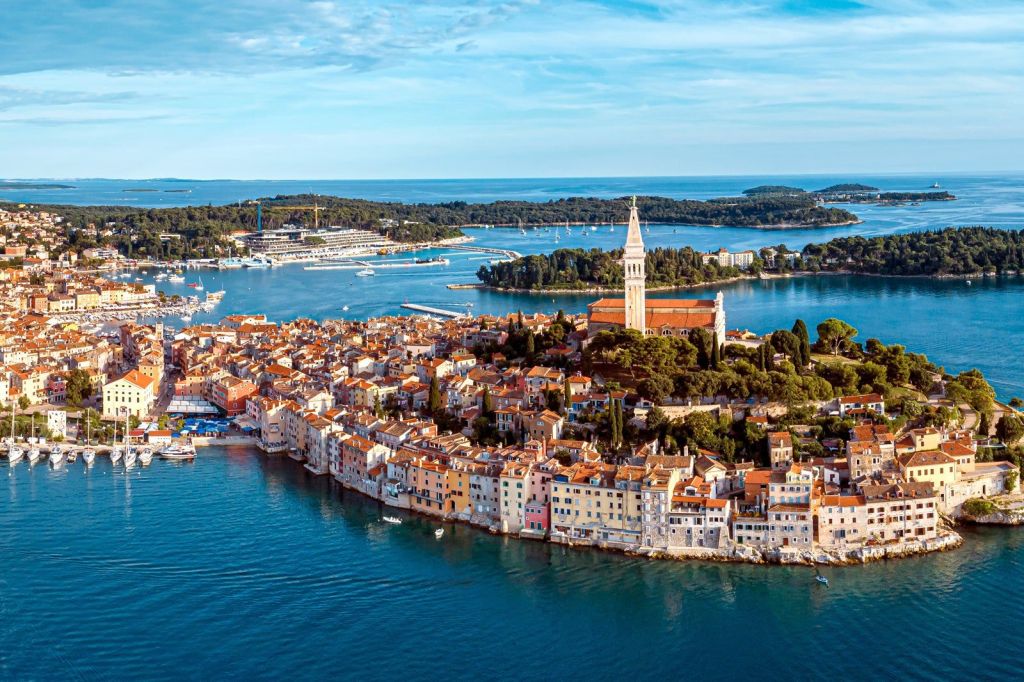
There’s a reason Rovinj appears on more Instagram grids than any other town in Croatia. The coloured houses stacked above the Adriatic, the island-like old town connected to the mainland by a narrow causeway, the bell tower of St. Euphemia catching the last light of the afternoon — it photographs beautifully from almost every angle. But the people who love Rovinj most are the ones who found their way past the photographs and into the town itself: through the unmarked alleys, down to the working harbour before the tourist boats start up, into the konobas that don’t have menus in English. Here’s how to get there.
The Old Town: Getting Pleasantly Lost
Rovinj’s old town is built on what was once a separate island, joined to the mainland in the eighteenth century when the channel between them was filled in. The street plan reflects this — concentric rings of narrow lanes winding up toward the hilltop church, with no real logic to the grid because there never was one. This is not a place to navigate with a map open. Put your phone away and walk. You will get lost. You will come out somewhere unexpected. This is the correct way to experience Rovinj’s old town, and it takes about an hour before the disorientation becomes pleasure.
The main drag — Grisia Street — runs from the harbour up to St. Euphemia and is lined with artists’ studios and galleries. In August it hosts an open-air art exhibition that takes over the entire street, which is either charming or overwhelming depending on the crowds. The lanes to either side of Grisia are quieter and in many ways more interesting: laundry strung between windows, cats on sun-warmed steps, the occasional doorway opening into a courtyard that has looked the same for three hundred years.
St. Euphemia: The Church Above Everything
The Church of St. Euphemia sits at the very top of the old town hill, and its eighteenth-century bell tower — modelled on the campanile in Venice — is visible from most of the surrounding sea. The church itself contains the sarcophagus of St. Euphemia, a third-century Christian martyr whose remains, according to local tradition, arrived in Rovinj by miraculous means in 800 AD: an enormous stone sarcophagus appeared on the shore one morning, and no one could move it until a small boy with two young oxen managed the task without effort. The town took this as a sign and built accordingly.
The tower is climbable, and the view from the top — over the terracotta rooftops of the old town, across the harbour, and out to the Rovinj archipelago of small islands — is one of the better urban panoramas in the Adriatic. Go in the morning or late afternoon; midday in summer the climb is punishing and the light is flat.
The Harbour and the Working Town
Rovinj has been a fishing town for most of its history, and the working harbour on the south side of the old town is where that history is still legible. Early morning — before seven, before the cafes fill up — the fishing boats come in and the catch gets unloaded at the small fish market on the harbour’s edge. It’s not a large or theatrical operation, but watching the fishermen sort the night’s catch while the town is still quiet is one of the more grounding ways to start a day in Rovinj.
The harbour promenade fills up through the morning with cafes and the boats offering island excursions. By midday it’s genuinely crowded in summer. The antidote is to walk south along the coastal path toward the Punta Corrente forest park — a protected area of Aleppo pine and holm oak with rocky coves for swimming that the majority of day-trippers never reach. Fifteen minutes of walking separates you from the crowd.
The Islands: A Short Boat Ride Away
Rovinj sits at the centre of a small archipelago of fourteen islands, most of them uninhabited. The largest, Crveni otok (Red Island), is connected by regular water taxis from the harbour and has beaches, a hotel, and the ruins of a Benedictine monastery. Sveti Andrija, nearby, is quieter and wilder. The best swimming spots around Rovinj are often reached by boat rather than on foot — a kayak or small rental boat opens up coves that the tour boats can’t reach.
The boat trip out to the islands at dusk, with the old town silhouetted behind you and the light going gold over the water, is one of those Istrian experiences that’s worth the small logistical effort of organising it. Any of the rental operators along the harbour can set you up.
Where to Eat
The restaurants directly on the harbour and along the main tourist promenades are, with a few exceptions, not where you want to be eating. The kitchens catering primarily to volume and turnover are visible from the laminated multilingual menus and the hosts standing outside calling people in. Step away from the waterfront and the quality improves immediately.
The old town’s back lanes have a handful of genuinely good small restaurants and konobas. Look for places where the menu is short, changes with the season, and where the fish was local that morning. The daily market near the harbour — small but well-stocked — is a good reference point: the restaurants buying from it will be serving better produce than those ordering from a wholesaler. For seafood, Rovinj is excellent — the day-boat catch here is as fresh as it gets anywhere on the Istrian coast.
The surrounding hills and inland area have agroturizmi worth the short drive — if you’re based in Rovinj for a few days, an inland lunch at a working farm is a good counterpoint to the coastal restaurant scene. The contrast between the two is part of what makes Istria interesting.
When to Visit
Rovinj in July and August is busy. Not unpleasantly so if you’re prepared for it — the town is large enough to absorb its summer crowds better than smaller Istrian towns — but the shoulder seasons are when it’s most itself. May and June bring warm weather, open water, and a town still finding its rhythm after winter. September and October are arguably the best months: the sea is still warm, the summer crowds have thinned, and the food calendar shifts into truffle and harvest season. November through March, Rovinj is quiet, some restaurants close, and the old town belongs almost entirely to its residents. This is a good time to visit if what you want is the place rather than the experience of being in the place.
Practical Notes
Cars are not permitted in the old town. There are parking areas on the approach to the peninsula — arrive early in summer or expect to park some distance away and walk. The old town’s cobbled streets and steep inclines are not particularly accessible for pushchairs or wheelchairs; the harbour-level promenade is easier going.
Rovinj is well connected by bus from Pula (around 45 minutes) and Poreč (around an hour). It’s also the best base for exploring the surrounding area — the coastal coves, the Lim Fjord to the north, and the inland hill towns of central Istria are all within comfortable day-trip distance. If you’re only visiting one town on the Istrian coast, Rovinj is the right choice. If you’re visiting several, make it the one you stay in longest.


Leave a Reply